The ninth International Conference on Interdisciplinary Urban Studies (City+2026@Mytilene) was recently held in Greece. Professor Li Hao from the School of Urban Construction (SUC) at Beijing City University (BCU) attended by invitation and delivered an academic presentation entitled “A Spatial Construction Framework for Human-Machine Symbiotic Cities—‘Human-Machine Friendly’ Scenario Analysis and Spatial Strategies”.
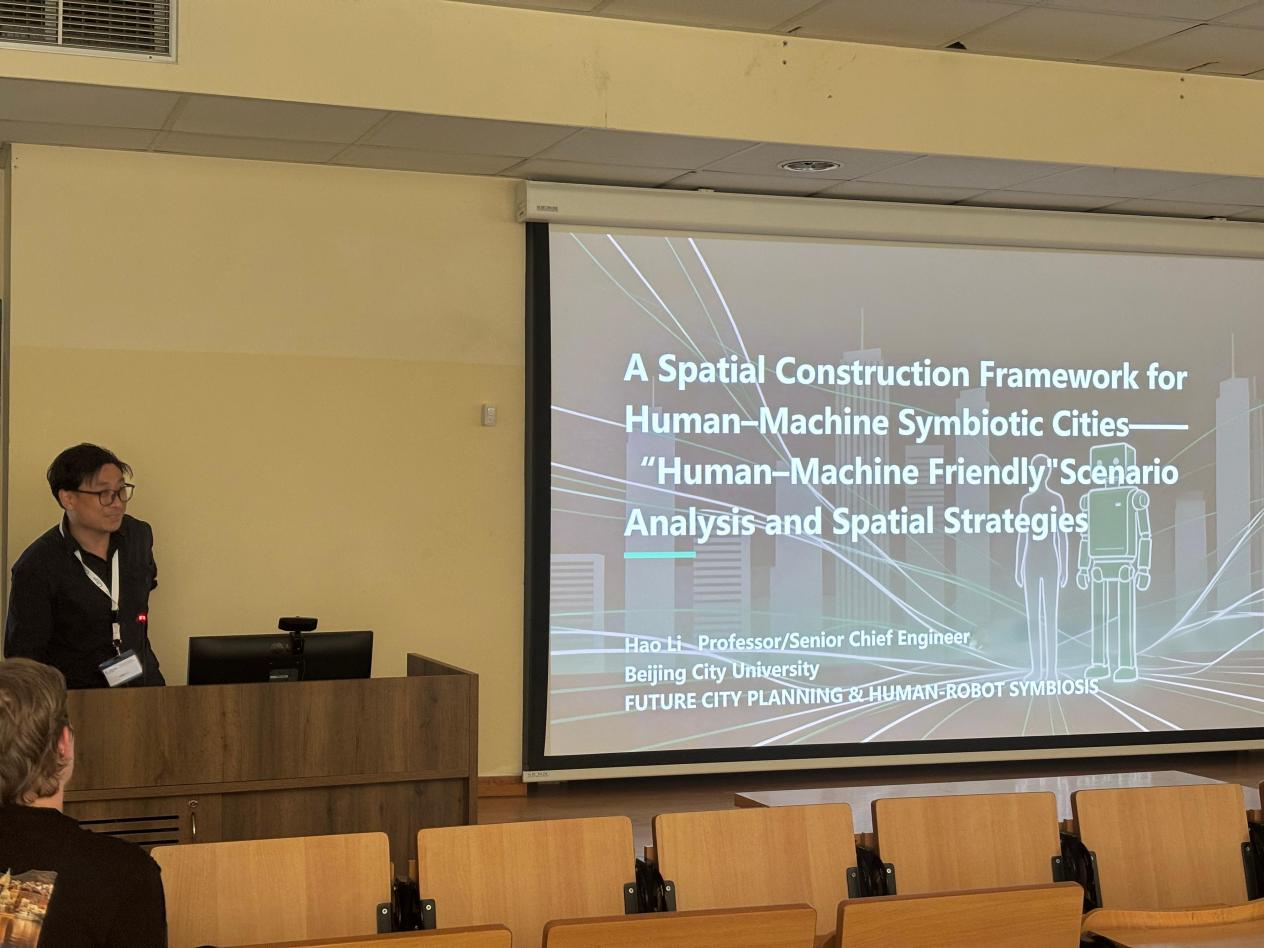
Professor Li noted that as embodied intelligence technologies advance and a growing variety of intelligent agents enter urban public spaces, urban planning needs to address the requirements of humans and intelligent agents working together. Conventional approaches to spatial organisation face new questions in the age of artificial intelligence. Against this backdrop, he presented a research framework and preliminary ideas for constructing urban spaces that support human-machine symbiosis, offering a new perspective on spatial planning for a society shaped by intelligent technologies.
The conference was jointly organised by the Department of Geography at the University of the Aegean in Greece and the City+ International Association for Interdisciplinary Urban Studies. Under the theme “Improving Liveability for Urban and Rural Settings”, it brought together university scholars, planners and technology experts from multiple countries for discussions on urban planning and design, smart cities and geographic artificial intelligence, urban development and governance, and climate change and urban resilience. As an international academic network for interdisciplinary urban studies, City+ includes members from the University of Cambridge, the University of Oxford, University College London, Delft University of Technology, Politecnico di Milano, The University of Hong Kong, Tongji University and Zhejiang University, among other institutions. Through its annual conferences, it promotes exchange and collaboration across urban planning, geography, artificial intelligence and related disciplines. Professor Li’s participation highlighted BCU’s research progress at the intersection of urban and rural planning and artificial intelligence, and further strengthened academic ties with relevant universities and research institutions in China and abroad.